This is
Not...
DARTS & LAURELS
"This is Not... Darts & Laurels"
is not written by Gloria Cooper, deputy
executive simulator, whose Colombia Journalism
Review showed
desperation in the face of the Authentic
Journalism Renaissance
by launching an ad hominem attack on
Narco News publisher
Al Giordano this month, calling him, in a caption
for a staged (!) photo,
a "worm," accompanied by an error-laden
article. We, at Salón Chingón,
thought that was pretty funny, and so now we'll
have some fun with
the gatekeepers at CJR who couldn't shoot straight...
LAUREL  In the new issue of Columbia Journalism Review
the magazine finally noticed a story it has avoided
for two-and-a-half years:
CJR wrote that Narco News contains "solid
and incisive reporting."
LAUREL
CJR also noted that Narco News publisher
Al Giordano's "watchdog role among journalists
in Latin America,
and his recent involvement in a landmark
libel case,
have further raised his profile."
DART
In the new issue of Columbia Journalism Review
the magazine finally noticed a story it has avoided
for two-and-a-half years:
CJR wrote that Narco News contains "solid
and incisive reporting."
LAUREL
CJR also noted that Narco News publisher
Al Giordano's "watchdog role among journalists
in Latin America,
and his recent involvement in a landmark
libel case,
have further raised his profile."
DART  CJR never
covered that "landmark libel case" as it was
happening in the years 2000 and 2001, nor the
December 2001 New York
Supreme
Court decision extending First Amendment protections to all Internet
journalists,
breaking the monopoly of the commercial media protection
under the "Sullivan v. NY Times"
doctrine:
A story that ocurred in their front yard.
DART While making
much ado about its recent staged
World
Wrestling
match with the New York Times over a supposedly "staged"
photo,
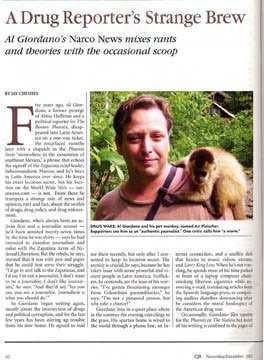
CJR also used "a staged photo" of Al
Giordano and a monkey.
How do we know? We staged it! . (Giordano did tell
them that it was from his
camera, suggesting it was, duh... Staged!)
CJR's stones thrown against
NY Times photographer Edward Keating - exonerating
the newspaper
and scapegoating one of the last Authentic Journalists
left on 43rd Street
- were tossed from a glass monkey cage. Who's the
monkey now?
CJR never
covered that "landmark libel case" as it was
happening in the years 2000 and 2001, nor the
December 2001 New York
Supreme
Court decision extending First Amendment protections to all Internet
journalists,
breaking the monopoly of the commercial media protection
under the "Sullivan v. NY Times"
doctrine:
A story that ocurred in their front yard.
DART While making
much ado about its recent staged
World
Wrestling
match with the New York Times over a supposedly "staged"
photo,
CJR also used "a staged photo" of Al
Giordano and a monkey.
How do we know? We staged it! . (Giordano did tell
them that it was from his
camera, suggesting it was, duh... Staged!)
CJR's stones thrown against
NY Times photographer Edward Keating - exonerating
the newspaper
and scapegoating one of the last Authentic Journalists
left on 43rd Street
- were tossed from a glass monkey cage. Who's the
monkey now?
WHAT'S WRONG WITH
THIS PICTURE?
The Staged Photo in Columbia Journalism
Review:
 The CJR caption calls Giordano a "worm"
and inaccurately
refers to "Ari Fleischer" (right) as Giordano's
"pet
monkey." While Ari is the mascot of the
Narco News
School of Authentic Journalism, he's nobody's pet.
He roams free in the Amazon jungle, in the Chapare
region
of Bolivia: One of the many boneheaded errors by CJR.
DART Notice that
the photo is not credited to anybody.
When CJR was seeking a photo of Al, he emailed them
this one, with the
line "Credit: Narco News Agency." CJR failed
to disclose that it's subject
provided the photo. Without any photo credit, the
average reader would
think CJR took the photo. So there are messy intellectual
property issues
and questions of respect for photojournalists and
overall dishonesty problems
inherent in the CJR staged photo mini-scandal, too.
Aha, no wonder CJR
scapegoated NYT photojournalist Edward Keating! CJR's
snobbish contempt
for the working class of journalists extends to photographers,
too. CJR made
a mountain out of a molehill against Keating, including
an over-the-top opening
Editorial
in this month's issue. It's obviously not that big a deal. But
that CJR
engages in the same kind of behavior it makes a big
show of condemning
regarding "staged" photos does very strongly
suggest that it's pot-banging
regarding Keating is part and parcel of the simulation
of journalism ethics
issues conducted by CJR and the Times in order
to distract from the major
journalistic corruptions inherent in the work of both
periodicals.
DOUBLE LAUREL
New York magazine media
critic Michael
Wolff, edited by the fabulous Simon Dumenco,
reported
on
September
23rd how CJR's publisher, the Columbia University Graduate
School of Journalism, serves the New York Times
axis:
"In fact," wrote Wolff, "the real mission,
or the highest mission, of the
school may be to prepare its students to work specifically
for one paper:
the New York Times (Joe Lelyveld, the former
executive editor,
and many Times reporters are graduates, and
the Times
has enormous clout at the school)..."
LAUREL
VILLAGE VOICE "Press Clips" columnist, Cynthia
Cotts, in her
November 6th report, noted that "Columbia's School of
Journalism is the home of the Pulitzers and a training
ground for Times
employees," and cited "the Times'
cozy relationship with Columbia"
as giving CJR (the mag discloses that it is "published
by" Columbia
J-School) phony "ballast" in its
coverage of the Times.
LAUREL
CJR quoted Giordano accurately when he noted that
New York Times Colombian correspondent
Juan Forero is "a
US embassy 'Muppet.'" And let's face it,
CJR deserves a laurel for
at least addressing the headache to the industry that
is Narco News:
After all, it wasn't Forero who got three pages
and a staged photo from 'em!
DART Ex-NY Times
Mexico Bureau Chief Sam Dillon,
embittered over the embarrassing loss of his former
sinecure of corrupted
journalism, complained of Giordano to CJR, saying
""The guy became like
a stalker." In fact, Giordano never sought or
looked for Dillon. It was Dillon
who, in March of 1999, pursued Giordano,
via unsolicited phone calls
to his home, and threatened him not to publish
"the Banamex story,"
according
to Al's sworn affidavit on file in the New York Supreme Court.
DART The rookie
freelancer who CJR sent to do this
now-fracased attempted hit-piece against Giordano
and Narco News,
never gave Giordano the opportunity to respond that
any decent journalist
would give someone accused of a crime like "stalking."
Interestingly, when
the inept freelancer mentioned to Giordano that he
had interviewed Dillon,
Giordano reminded the rookie that he had pledged,
beforehand, to offer
the chance to respond because "Sam Dillon
is pathologically
dishonest." The rookie replied, dishonestly,
that Dillon said nothing
new and that no response would be necessary. The knowingly
false charge
of criminal behavior, of "stalking," is
per se libel, and that the CJR rookie
didn't offer the accused the fair opportunity to clear
the air displayed
malice and reckless disregard for the truth.
DART Come to think
of it, the suggestion, by CJR's photo
caption that Giordano has a "pet monkey,"
a completely invented fiction never
claimed by Giordano, might also constitute the false
suggestion of a crime
against environmental laws and treaties. What
if that monkey is part of an
endangered species? Trafficking in endangered species
is akin to trafficking in
narcotics: Illegal. The presumption that a "mascot"
("a person or thing believed
to bring good luck, " Oxford American Dictionary)
is a "pet" belonging to
Giordano was a real boner. If INTERPOL or PETA raids
our offices to
rescue "Ari," the Columbia University endowment
is gonna pay!
DART The rookie
freelancer, who made numerous bumbling
errors in his report, was also urged by Giordano to
interview Mexico's most
honest, courageous and legendary journalist Mario
Menéndez Rodríguez to
answer the knowingly false accusations made by the
pathologically dishonest
Sam Dillon against him. The rookie freelancer
was offered direct contact
with Menéndez, but was too lazy to call
him. He then quoted the
professional simulator Sam Dillon calling Menéndez's
daily Por Esto!
"a disreputable newspaper" and its report
on the narco-banker Roberto
Hernández "trash." (Dillon also said
that Giordano makes things up and has
"no credibility," charges that Al would
have hit out of the park, considering
the disgraced source, which is probably why
the rookie freelancer
refused to give him a chance to reply.) The rookie
freelancer, obviously,
was afraid to interview a giant of journalism like
Menéndez, as was Dillon
four years ago when he claimed to have investigated
the narco-banker
story. Cowards of a feather stick together! (And don't
think we didn't
notice the inherent racism in the charges
tossed at a Mexican journalist,
and the denial to him of a fair opportunity to respond:
Dillon and the
rookie apparently need one of those "sensitivity
classes" that are all the
rage at newspapers these days.) In any case, as for
reputable vs.
disreputable, New York Times circulation
is stagnant. But Por Esto!
keeps on growing: It's 11 years old and already the
third most widely read daily newspaper in all of Mexico.
LAUREL
To search engines like Google.com, that make it
possible for readers to investigate for themselves
the veracity of claims made
by all journalists. For example, the rookie journalist
repeatedly tried,
however ineptly, to portray Narco News' Giordano as
"an activist
first and a journalist second" and claimed that
"mainstream reporters cringe"
at "authentic journalism." But who is the
rookie freelancer to make such
judgments? Do a
Google search on Al Giordano and the word "journalist,"
and one finds more than 750 Internet pages dedicated
to the subject, most
of which refer to Giordano as the journalist. (And
this doesn't even count the
more than 100 web reports dedicated, in Spanish, to
Giordano as
"periodista," or others that cite his work
as a journalist in French, Italian,
Portuguese, German, etc.) But do a
Google search on the rookie
freelancer's
byline and the word "journalist," and one finds
only six
reports - two referring to the journalist Giordano,
and none
of them referring to the rookie freelancer as the
"journalist."
The Reader has to, as always, consider the messenger.
LAUREL
To Google's new wire service, Google News, which
features Narco News as one of its primary news sources,
but, interestingly,
doesn't consider CJR to be as worthy a news source.
LAUREL
To veteran Boston Globe reporter Brian McGrory,
the only "mainstream journalist" to ever
mention the rookie
freelancer's name who on January 16,
2001, referred to the rookie
freelancer as a "wannabe writer,"
and as a member of the "notoriously
persnickety salad fork crowd, a group that
often confuses
being obnoxious with being informed."
McGrory described CJR's
"wannabe writer" as one who "declared
in The New York Observer
last month, 'Boston is a small town with many astoundingly
bad restaurants.'
Perhaps he's still sore about being fired from
Boston magazine in November."
LAUREL
To our Salón Chingón collaborator and
photographer Kaia Porter, 21, who monitored
much of the
CJR rookie freelancer's "interview" with
Al Giordano - while
the rookie helped himself to large quantities of free
beer from the
newsroom fridge - who upon observing the rookie freelancer
on the
job, commented: "He's a journalist? He seems
like such a
non-entity. He seems more like a gerbil
than a journalist."
DART To the CJR
rookie freelancer, who confessed
to being a US Embassy "diplomat brat,"
a Columbia University
alumni (¿ya ven?), who chose to stay
in one of the most expensive
posh hotels - a dozen free brands of luxury colognes
and perfumed
soaps with each room! - of the impoverished
Third World City where he
met up with our News Team, who took a cheap shot at
Giordano's "crooked
teeth" in his failed CJR attack piece. The fact
is, Giordano's teeth aren't so
much crooked as they are chipped, from a fall from
an automobile when he
was eight. And coming from modest roots, Giordano's
family never had the
money for braces or dental surgery. What Giordano's
family did have, though,
in place of money, was character, ethics, creativity
in the face of economic
obstacles, and dignity. The poor little rich freelancer,
who has set himself up in
high-rent New York City to suck his way up into the
media establishment,
may have been born with a silver salad fork in his
mouth, but can't hide his
contempt for those not born into his "salad fork
crowd" spoiled brat privilege.
The CJR caption calls Giordano a "worm"
and inaccurately
refers to "Ari Fleischer" (right) as Giordano's
"pet
monkey." While Ari is the mascot of the
Narco News
School of Authentic Journalism, he's nobody's pet.
He roams free in the Amazon jungle, in the Chapare
region
of Bolivia: One of the many boneheaded errors by CJR.
DART Notice that
the photo is not credited to anybody.
When CJR was seeking a photo of Al, he emailed them
this one, with the
line "Credit: Narco News Agency." CJR failed
to disclose that it's subject
provided the photo. Without any photo credit, the
average reader would
think CJR took the photo. So there are messy intellectual
property issues
and questions of respect for photojournalists and
overall dishonesty problems
inherent in the CJR staged photo mini-scandal, too.
Aha, no wonder CJR
scapegoated NYT photojournalist Edward Keating! CJR's
snobbish contempt
for the working class of journalists extends to photographers,
too. CJR made
a mountain out of a molehill against Keating, including
an over-the-top opening
Editorial
in this month's issue. It's obviously not that big a deal. But
that CJR
engages in the same kind of behavior it makes a big
show of condemning
regarding "staged" photos does very strongly
suggest that it's pot-banging
regarding Keating is part and parcel of the simulation
of journalism ethics
issues conducted by CJR and the Times in order
to distract from the major
journalistic corruptions inherent in the work of both
periodicals.
DOUBLE LAUREL
New York magazine media
critic Michael
Wolff, edited by the fabulous Simon Dumenco,
reported
on
September
23rd how CJR's publisher, the Columbia University Graduate
School of Journalism, serves the New York Times
axis:
"In fact," wrote Wolff, "the real mission,
or the highest mission, of the
school may be to prepare its students to work specifically
for one paper:
the New York Times (Joe Lelyveld, the former
executive editor,
and many Times reporters are graduates, and
the Times
has enormous clout at the school)..."
LAUREL
VILLAGE VOICE "Press Clips" columnist, Cynthia
Cotts, in her
November 6th report, noted that "Columbia's School of
Journalism is the home of the Pulitzers and a training
ground for Times
employees," and cited "the Times'
cozy relationship with Columbia"
as giving CJR (the mag discloses that it is "published
by" Columbia
J-School) phony "ballast" in its
coverage of the Times.
LAUREL
CJR quoted Giordano accurately when he noted that
New York Times Colombian correspondent
Juan Forero is "a
US embassy 'Muppet.'" And let's face it,
CJR deserves a laurel for
at least addressing the headache to the industry that
is Narco News:
After all, it wasn't Forero who got three pages
and a staged photo from 'em!
DART Ex-NY Times
Mexico Bureau Chief Sam Dillon,
embittered over the embarrassing loss of his former
sinecure of corrupted
journalism, complained of Giordano to CJR, saying
""The guy became like
a stalker." In fact, Giordano never sought or
looked for Dillon. It was Dillon
who, in March of 1999, pursued Giordano,
via unsolicited phone calls
to his home, and threatened him not to publish
"the Banamex story,"
according
to Al's sworn affidavit on file in the New York Supreme Court.
DART The rookie
freelancer who CJR sent to do this
now-fracased attempted hit-piece against Giordano
and Narco News,
never gave Giordano the opportunity to respond that
any decent journalist
would give someone accused of a crime like "stalking."
Interestingly, when
the inept freelancer mentioned to Giordano that he
had interviewed Dillon,
Giordano reminded the rookie that he had pledged,
beforehand, to offer
the chance to respond because "Sam Dillon
is pathologically
dishonest." The rookie replied, dishonestly,
that Dillon said nothing
new and that no response would be necessary. The knowingly
false charge
of criminal behavior, of "stalking," is
per se libel, and that the CJR rookie
didn't offer the accused the fair opportunity to clear
the air displayed
malice and reckless disregard for the truth.
DART Come to think
of it, the suggestion, by CJR's photo
caption that Giordano has a "pet monkey,"
a completely invented fiction never
claimed by Giordano, might also constitute the false
suggestion of a crime
against environmental laws and treaties. What
if that monkey is part of an
endangered species? Trafficking in endangered species
is akin to trafficking in
narcotics: Illegal. The presumption that a "mascot"
("a person or thing believed
to bring good luck, " Oxford American Dictionary)
is a "pet" belonging to
Giordano was a real boner. If INTERPOL or PETA raids
our offices to
rescue "Ari," the Columbia University endowment
is gonna pay!
DART The rookie
freelancer, who made numerous bumbling
errors in his report, was also urged by Giordano to
interview Mexico's most
honest, courageous and legendary journalist Mario
Menéndez Rodríguez to
answer the knowingly false accusations made by the
pathologically dishonest
Sam Dillon against him. The rookie freelancer
was offered direct contact
with Menéndez, but was too lazy to call
him. He then quoted the
professional simulator Sam Dillon calling Menéndez's
daily Por Esto!
"a disreputable newspaper" and its report
on the narco-banker Roberto
Hernández "trash." (Dillon also said
that Giordano makes things up and has
"no credibility," charges that Al would
have hit out of the park, considering
the disgraced source, which is probably why
the rookie freelancer
refused to give him a chance to reply.) The rookie
freelancer, obviously,
was afraid to interview a giant of journalism like
Menéndez, as was Dillon
four years ago when he claimed to have investigated
the narco-banker
story. Cowards of a feather stick together! (And don't
think we didn't
notice the inherent racism in the charges
tossed at a Mexican journalist,
and the denial to him of a fair opportunity to respond:
Dillon and the
rookie apparently need one of those "sensitivity
classes" that are all the
rage at newspapers these days.) In any case, as for
reputable vs.
disreputable, New York Times circulation
is stagnant. But Por Esto!
keeps on growing: It's 11 years old and already the
third most widely read daily newspaper in all of Mexico.
LAUREL
To search engines like Google.com, that make it
possible for readers to investigate for themselves
the veracity of claims made
by all journalists. For example, the rookie journalist
repeatedly tried,
however ineptly, to portray Narco News' Giordano as
"an activist
first and a journalist second" and claimed that
"mainstream reporters cringe"
at "authentic journalism." But who is the
rookie freelancer to make such
judgments? Do a
Google search on Al Giordano and the word "journalist,"
and one finds more than 750 Internet pages dedicated
to the subject, most
of which refer to Giordano as the journalist. (And
this doesn't even count the
more than 100 web reports dedicated, in Spanish, to
Giordano as
"periodista," or others that cite his work
as a journalist in French, Italian,
Portuguese, German, etc.) But do a
Google search on the rookie
freelancer's
byline and the word "journalist," and one finds
only six
reports - two referring to the journalist Giordano,
and none
of them referring to the rookie freelancer as the
"journalist."
The Reader has to, as always, consider the messenger.
LAUREL
To Google's new wire service, Google News, which
features Narco News as one of its primary news sources,
but, interestingly,
doesn't consider CJR to be as worthy a news source.
LAUREL
To veteran Boston Globe reporter Brian McGrory,
the only "mainstream journalist" to ever
mention the rookie
freelancer's name who on January 16,
2001, referred to the rookie
freelancer as a "wannabe writer,"
and as a member of the "notoriously
persnickety salad fork crowd, a group that
often confuses
being obnoxious with being informed."
McGrory described CJR's
"wannabe writer" as one who "declared
in The New York Observer
last month, 'Boston is a small town with many astoundingly
bad restaurants.'
Perhaps he's still sore about being fired from
Boston magazine in November."
LAUREL
To our Salón Chingón collaborator and
photographer Kaia Porter, 21, who monitored
much of the
CJR rookie freelancer's "interview" with
Al Giordano - while
the rookie helped himself to large quantities of free
beer from the
newsroom fridge - who upon observing the rookie freelancer
on the
job, commented: "He's a journalist? He seems
like such a
non-entity. He seems more like a gerbil
than a journalist."
DART To the CJR
rookie freelancer, who confessed
to being a US Embassy "diplomat brat,"
a Columbia University
alumni (¿ya ven?), who chose to stay
in one of the most expensive
posh hotels - a dozen free brands of luxury colognes
and perfumed
soaps with each room! - of the impoverished
Third World City where he
met up with our News Team, who took a cheap shot at
Giordano's "crooked
teeth" in his failed CJR attack piece. The fact
is, Giordano's teeth aren't so
much crooked as they are chipped, from a fall from
an automobile when he
was eight. And coming from modest roots, Giordano's
family never had the
money for braces or dental surgery. What Giordano's
family did have, though,
in place of money, was character, ethics, creativity
in the face of economic
obstacles, and dignity. The poor little rich freelancer,
who has set himself up in
high-rent New York City to suck his way up into the
media establishment,
may have been born with a silver salad fork in his
mouth, but can't hide his
contempt for those not born into his "salad fork
crowd" spoiled brat privilege.
 Artist's Portrait of a CJR "Reporter"
DART Again, to the
rookie freelancer, for thinking himself
qualified after six years of roaming the wilderness
of journalism looking for
mercenary work, who thinks he can judge who is a "journalist"
and who is not.
Here are the facts he knew but denied to CJR's readers:
Narco News
publisher Giordano spent seven years as a full time
beat reporter - cops,
courts and politics - for the Springfield Advocate
and the Boston Phoenix.
He spent three years as a daily AM radio host. He
has filed more than
1,000 stories in the commercial press, never missing
a deadline. He has
published in the Washington Post, American
Journalism Review
(When it was WJR, under legendary editor Bill
Monroe), The Nation,
Evergreen Review, and scores of newspapers
and magazines. He was
declared a journalist by the New York Supreme Court.
All of this
information was directly reported, additionally, to
CJR's fact checker
(who did correct some inaccurate statements originally
made by the rookie).
DART The rookie reporter
has also lost any credibility
he might have had in the future writing
about the drug war - a story
that readers around the world recognize as valid and
led by the work
of Authentic Journalists who take major risks to report
it.
That was the story, but he couldn't see it even as
it bit him in the ass.
Artist's Portrait of a CJR "Reporter"
DART Again, to the
rookie freelancer, for thinking himself
qualified after six years of roaming the wilderness
of journalism looking for
mercenary work, who thinks he can judge who is a "journalist"
and who is not.
Here are the facts he knew but denied to CJR's readers:
Narco News
publisher Giordano spent seven years as a full time
beat reporter - cops,
courts and politics - for the Springfield Advocate
and the Boston Phoenix.
He spent three years as a daily AM radio host. He
has filed more than
1,000 stories in the commercial press, never missing
a deadline. He has
published in the Washington Post, American
Journalism Review
(When it was WJR, under legendary editor Bill
Monroe), The Nation,
Evergreen Review, and scores of newspapers
and magazines. He was
declared a journalist by the New York Supreme Court.
All of this
information was directly reported, additionally, to
CJR's fact checker
(who did correct some inaccurate statements originally
made by the rookie).
DART The rookie reporter
has also lost any credibility
he might have had in the future writing
about the drug war - a story
that readers around the world recognize as valid and
led by the work
of Authentic Journalists who take major risks to report
it.
That was the story, but he couldn't see it even as
it bit him in the ass.
DART CJR committed a
bumbling inconsistency in this
month's issue. On the one hand, the rookie reporter's
article contained
multiplie complaints about the length of Narco
News stories
(could it be that Narco News has proved that long-form
journalism
isn't dead, and that it is precisely Narco News
that has picked up
the torch once lit by Rolling Stone in reviving
the genre that so
many had feared disappeared?). On the other
hand, the same issue
of CJR has a
6,000-word article praising the long articles in Atlantic
Monthly,
including "an extraordinary 70,000-word series." So
which is
it? We say, what's good for the Atlantic is good for
the Caribbean, kids!
LAURELS
To all the "mainstream journalists" who, contrary to
CJR's invented fictions, have not "cringed"
at all regarding Narco News
and Giordano's renaissance in Authentic Journalism.
They have mentioned
us, pro and con, but all have been accurate, fair
and professional:
Howard Kurtz of the Washington Post,
Mark Jurkowitz of the Boston
Globe, Alexandra Marks, of the Christian
Science Monitor, Ken
Layne, of the LA Examiner, Cynthia
Cotts, of the Village Voice,
Dan Kennedy and Clif Garboden of Giordano's
alma mater, the Boston
Phoenix, Danny Schechter, of the Media
Channel, Amy Langfield,
of Online Journalism Review, Mim Udovitch,
of Rolling Stone,
Jim Romenesko, of the Poynter Institute's Media
News, Sean
Dodson, of the Guardian of London, Mexican
national political columnists
Carlos Ramírez, Pepe Martínez, Beatríz
Fregoso, Alvaro Cepeda
Neri, and Juan Pablo Becerra Acosta,
Pulitzer prize winner Gary Webb,
Salon.com's Jan Shreve, and of course Mario
Menéndez, Mexico's
grandest daily newspaper editor and founder of the
Authentic Journalism
Renaissance, not to mention the rest of The
Faculty of the Narco News
School of Authentic
Journalism. , and SO MANY
OTHERS.
All of them got the facts right. Columbia Journalism
Review is the only
publication that distorted instead of reported. And
still, even with their
malice and reckless disregard for the truth, we come
out smelling like a rose.
THE BIG DART The
biggest dart, though, goes not to the
rookie freelancer, but, rather, to Mike Hoyt, Executive
Simulator of
Columbia Journalism Review.
Michael Hoyt. simulator, we will address these comments
to you:
You have prostituted yourself
(again) to the agenda of the corrupted
New York Times - embarrassed time and time
again by the new scrutiny
offered by Authentic Journalists to its correspondents'
misbehaviors in Latin
America - in your magazine's efforts to marginalize
our work.
Yes, they have their panties all up in a bunch
up at 43rd Street:
The First Amendment monopoly by commercial media is
over:
It now belongs to us, and to all journalists everywhere.
That would have been a great story for your
rag. But, alas...
You screwed up royally, Mike, and here's why: You
sent a cub reporter,
incompetent for even a hit-piece, to do the job of
a professional. You didn't
send an experienced drug war reporter who would know
the complex beat at
issue. You didn't send an experienced court reporter
who would understand
the significance of our New York Supreme Court victory.
You didn't send a
reporter who could speak Spanish in Latin America
(maybe that one would
not have feared his or her duty to interview a Mexican
journalist of 1,000 times
the rookie's stature). Those would have all
been interesting stories.
But you didn't send anyone with any gravitas
at all!
For the details on your magazine's factual errors
and ethical lapses, see our
accompanying story on how
an Authentic Editor might have rescued this story.
When is Columbia Journalism Review going
to break the shackles
of its servitude to the petty interests of the uptown
Media Establishment?
When are you aspiring gatekeepers of journalism
going to realize
that in December 2001 we took the hinges off the gates?
When will you declare independence from the NYT-Pulitzer-CPJ-CJR-
Columbia University clique and stop trying,
in vain, to circle the wagons?
It doesn't matter when!
We already have more readers than you do!
CJR, review thyself!
Throwing darts while resting on your laurels, Hoyt?
Y'all tried to hit us, and you just made us stronger.
¡Pendejos!
Add your darts and
laurels:
Today, in the Student
Assembly Hall...
Authentic Journalism
Review
Volume I, Issue 1
A Special Presentation by the...
Banner donated by
David
VandePanne
Publisher's
Postscript, November 27: Columbia
Journalism Review finally posted this disaster of an article
to its website. Executive Simulator Mike Hoyt was so proud of
it, he waited until the
day before Thanksgiving to publish it online! Precisely when the fewest
people would see it! Way to go, Mike! Sometimes people are transparent
even when they try not to be.
For More Narco News,
click
here

Authentic Journalism vs. Authentic
Gerbilism